Artificial intelligence is dominating business conversations. Every week there’s a new tool promising to transform productivity, automate entire departments or replace repetitive work altogether.
For many businesses, the pressure to “do something with AI” has never been greater.
But amid all the excitement, one question often gets overlooked:

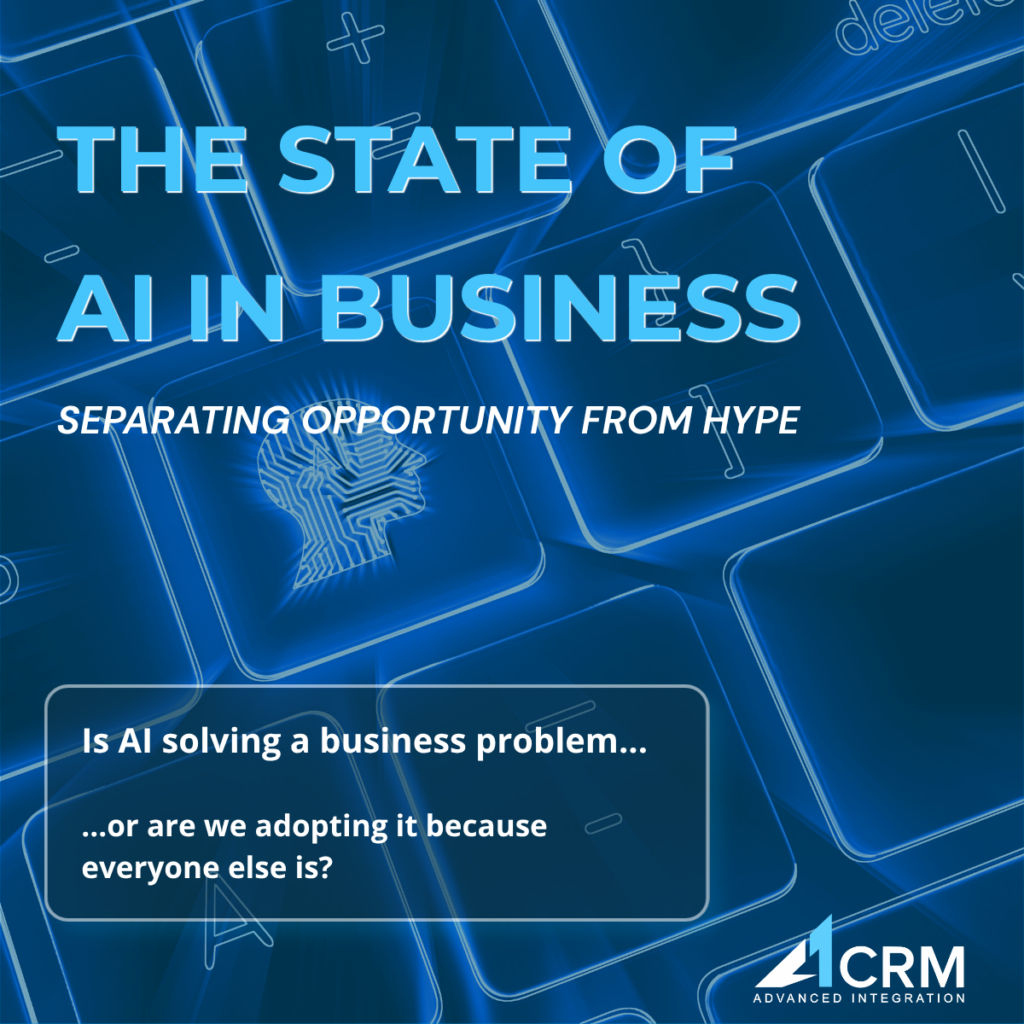
Is AI actually solving a business problem, or are we adopting it simply because everyone else is?
Richard Price, Founder and Solution Architect at A1CRM, has spent more than 15 years helping businesses across New Zealand implement CRM solutions that improve efficiency and strengthen customer relationships. Throughout that time, he’s seen countless technology trends emerge. Some have fundamentally changed the way businesses operate, while others have faded almost as quickly as they arrived.
AI is different.
It has enormous potential to reshape the way businesses work, but only when it’s implemented for the right reasons.
The businesses gaining the greatest value from AI aren’t necessarily the ones using the most AI.
They’re the ones using it strategically.
Technology Should Serve the Business
At A1CRM, we’ve always believed technology should make people’s jobs easier, not more complicated.
Whether it’s CRM software, workflow automation or artificial intelligence, the goal should always be the same:
- Reduce repetitive work.
- Improve customer experiences.
- Support better decision-making.
- Allow employees to spend more time doing work that genuinely requires human expertise.

Technology shouldn’t create extra complexity simply because a new tool has become available.
Before implementing AI, businesses should first ask themselves:
What problem are we trying to solve?
If there isn’t a clear answer, AI probably isn’t the place to start.
“Technology should remove the mundane work so people can focus on the work that matters.”
— Richard Price, Founder & Solution Architect, A1CRM
More AI Doesn’t Always Mean Better Results
One of the biggest misconceptions surrounding AI is that more automation automatically leads to greater productivity.
In reality, more productivity doesn’t always produce better outcomes.
Take lead generation as an example.
Modern AI tools can identify and contact thousands of potential customers in a fraction of the time it would take a salesperson.
On paper, that sounds incredibly efficient.
But if those leads are poorly qualified, sales teams may spend significantly more time filtering unsuitable opportunities than building relationships with customers who are genuinely ready to buy.
Likewise, an AI agent might send hundreds of personalised emails every day.
If those emails generate fewer meaningful conversations, has the business actually become more productive?
Not necessarily.

Businesses should measure success by outcomes, not activity. More emails. More reports. More phone calls. These metrics only matter if they improve customer relationships, increase revenue or create measurable business value.
Understanding the Real Cost of AI
Another misconception is that AI is inexpensive.
While many AI tools have relatively low entry costs, businesses often underestimate the ongoing investment required to use them effectively.
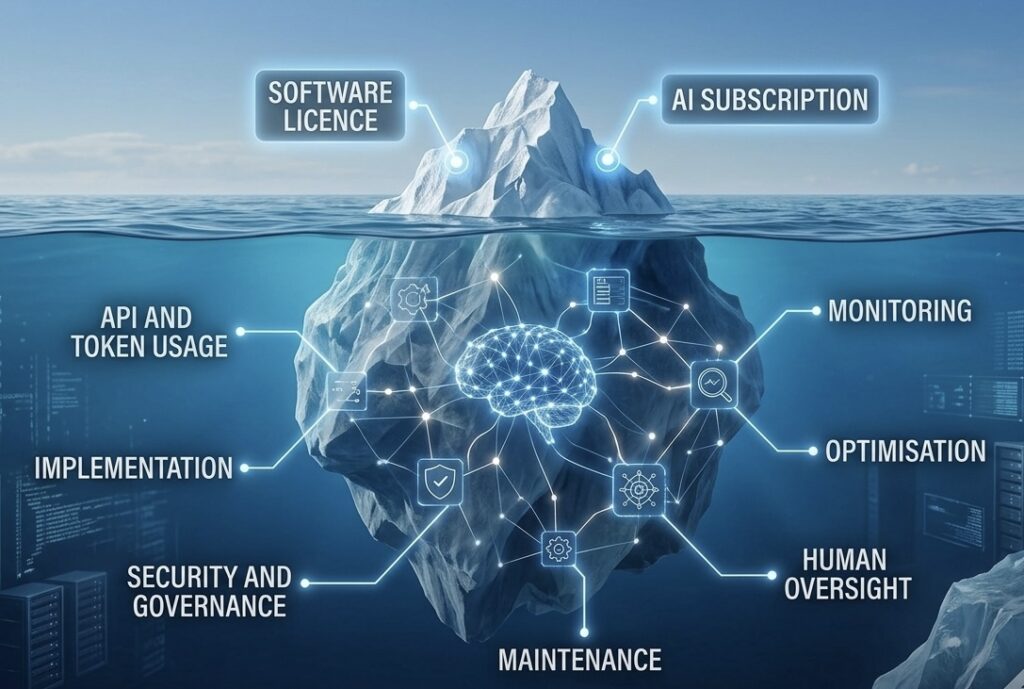
Depending on the platform, costs may include:
- Software licences
- AI agent subscriptions
- API and token usage
- Processing costs
- Implementation and configuration
- Security and governance
- Ongoing maintenance and optimisation
Many AI services operate on usage-based pricing, meaning costs increase as the technology is used more frequently.
Even large businesses have found that AI expenses can grow much faster than anticipated. In 2026, Uber reported exhausting its planned budget for AI coding tools far sooner than expected, prompting the company to introduce spending controls for engineering teams.
It’s not only the big global players either. We’ve experienced this ourselves at A1CRM. Over the past year, we’ve designed and built AI agents internally, testing where they genuinely add value. In some cases, the technology performed exactly as intended, but once real-world usage began, the ongoing operating costs made certain implementations commercially impractical.
It reinforced an important lesson… The true cost of AI often isn’t building it. It’s running it.
For smaller businesses, this serves as an important reminder that the purchase price is only one part of the equation. The long-term operational cost of AI should always be considered before implementation.
Cost isn’t the only challenge businesses need to think about. Understanding how AI actually “thinks” is just as important.
AI Is Like Hiring an Eager 18-Year-Old
One analogy we often use at A1CRM is to think of today’s AI as hiring an enthusiastic 18-year-old employee.
They’re intelligent.
They’re eager to help.
They’re capable of doing great work.
But they still need guidance, context, and oversight.
Faced with a difficult customer situation, they may genuinely believe they’re doing the right thing while unintentionally creating a larger problem.
Generative AI behaves similarly.
Large language models are designed to produce helpful responses, but they don’t inherently understand your company’s commercial objectives, internal policies, or appetite for risk.
That’s why businesses still need people involved in important decisions.
A well-known example involved Air Canada’s website chatbot, which provided incorrect information about the airline’s bereavement fare policy. A Canadian tribunal later held the airline responsible for the misleading information and ordered it to compensate the customer.
The lesson wasn’t that AI can’t be trusted. It was that businesses remain accountable for the decisions and information their AI provides. AI doesn’t remove responsibility; it changes how that responsibility needs to be managed.
AI Should Support People, Not Replace Them
Much of the public conversation about AI focuses on replacement.
Will AI replace customer service?
Will it replace salespeople?
Will it replace knowledge workers?
In reality, the most successful AI implementations we’ve seen don’t replace people; they make them more effective.
AI excels at repetitive, time-consuming work:
- Summarising information
- Organising data
- Drafting content
- Identifying patterns
- Preparing documentation
People, however, remain essential for:
- Building trust
- Making judgement calls
- Understanding context
- Managing relationships
- Solving complex problems
- Taking responsibility for important decisions
The goal shouldn’t be to remove humans from the process.
It should be to remove the repetitive tasks that stop people from doing their best work.
The 90/10 Rule

At A1CRM, we often describe this philosophy as the 90/10 Rule.
If AI can complete 90% of a repetitive task accurately and efficiently, let it.
- Allow it to prepare the first draft.
- Summarise the meeting.
- Organise the information.
- Create the foundation.
But the final 10% – the review, judgement and decision-making should remain with an experienced person.
That final step is where business context, professional expertise and accountability matter most.
Trying to automate every last decision often introduces unnecessary risk while delivering very little additional value.
“If AI can do 90% of the repetitive work, let it. But the final 10% – the judgement, context and accountability should always stay with people.”
— Richard Price, Founder & Solution Architect, A1CRM
So, What Is the State of AI in Business?
AI is no longer a “future technology.”
It’s here.
The conversation is no longer about whether businesses should explore AI. It’s about how they can adopt it responsibly and strategically.
Success won’t come from implementing the newest AI tool.
It will come from understanding where AI genuinely adds value and where traditional workflows, business processes, and human expertise remain the better solution.
The businesses that succeed won’t be those chasing every new trend.
They’ll be the businesses asking better questions, implementing AI with purpose, and ensuring technology always serves their people, not the other way around.
Looking Ahead
This article is the first in our AI in Business series.
Over the coming weeks, we’ll explore some of the biggest questions businesses are asking about AI, including:
- How to implement AI securely and ethically.
- The different types of AI and where each is most effective.
- How to automate business processes without creating unnecessary risk.
- Real-world examples of AI solving everyday business problems.
- Why connected AI ecosystems will shape the next generation of business technology.
AI will continue to evolve. Models will become faster, more capable and more affordable.
But the businesses that benefit most won’t be the ones adopting every new tool. They’ll be the ones making thoughtful decisions about where AI genuinely creates value.
Technology should support your people, strengthen your business and solve real problems. When AI is implemented with that mindset, it becomes more than a trend, it becomes a competitive advantage.