
AI can answer customer enquiries, process invoices, draft proposals, record meetings and gather information from across the web. The list of things it can do grows almost every day.
For businesses, though, capability is only the starting point.
The more useful question is…
Should we allow AI to do this particular task, in this particular way?
Throughout this series, we’ve approached AI through three connected ideas: Purpose, Control and Principles. Purpose asks what AI should achieve for the business. Control asks how to implement it safely. Principles ask where we should draw the line, even when a tool makes something possible.
That third question matters because an AI tool can save time and still create problems for customers, employees or the people whose work it uses.
Help your people do better work
Consider an accounts team processing supplier invoices. AI may be able to read an invoice, extract its details and suggest how to allocate it. That can reduce hours of repetitive scanning and data entry.
It also gives the team more time for the work that needs their judgment: checking unusual transactions, resolving discrepancies and speaking with customers about overdue accounts. The goal is to remove the mechanical work that gets in the way, while giving people more room to use their expertise.
The same principle applies elsewhere. A meeting notetaker can capture key points and help draft a follow-up email. A person should still check that the summary is accurate and that the email reflects what was agreed. AI can help prepare the work, but someone needs to take responsibility for what goes out.

Be clear about the role AI is playing
There is a meaningful difference between an AI assistant helping someone book an appointment and one giving advice in a sensitive customer situation.
For a straightforward booking, the task can be tightly defined. The system can check availability, offer options and hand the conversation to a person when it cannot help. But a complaint, a complex financial question or a conversation requiring empathy needs much more care. A plausible answer is not necessarily the right answer.
Businesses should decide in advance what an AI tool may answer, when it must ask for help and when a customer should be able to reach an actual person. They should also consider whether customers need to know they are interacting with AI, particularly when the interaction could affect an important decision.
The business remains responsible for the experience it creates. That responsibility cannot be passed to the software.
Consider where the information comes from
AI makes it easy to gather information and turn it into new material. Ease of access, however, is not the same as permission to use it.
There is a difference between using a supplier’s information for an intended purpose, such as checking prices for a quote, and copying someone else’s researched article to produce commercial content of your own. Before asking an AI tool to collect or reuse material, consider its source, the owner’s terms and the effort behind it.
The same care applies to information inside your business. If a tool records a meeting or uses customer data, who has agreed to that use? What will be stored? Who can access the recording, transcript or summary? These questions belong in the design of the process, before the tool becomes part of everyone’s routine.
Five questions to ask before you deploy AI
At A1CRM, we use five questions to test whether an AI use case makes sense:
Purpose: What genuine business problem does it solve, and what value will it create?
Data: What information will it see, store and generate? Where does that information come from?
Access: What systems can it use, and what actions is it allowed to take?
People: Who benefits, and who could be disadvantaged or misled?
Accountability: Which person is responsible for checking the outcome and putting things right if it goes wrong?
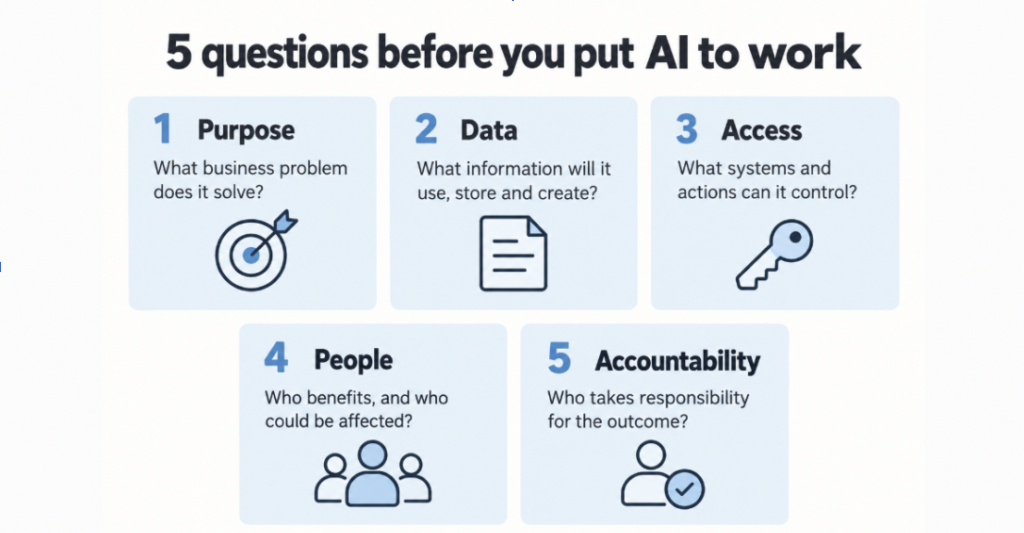
These questions help turn a broad ambition like “let’s use AI for customer service” into a workable decision. They reveal where a narrow, well-defined task may be useful and where human review or a different approach is needed.
They also provide guidance for staff. Without clear rules, people may start using separate AI tools to save time, each with different access to business and customer information. A shared approach gives employees the confidence to use AI appropriately and gives the business a clearer view of what is happening.
A final test
Before putting an AI tool into use, ask yourself: would we be comfortable explaining exactly how it works to a customer, an employee or the person whose information it uses?
Could you explain what the tool is allowed to do, where its information comes from, how its output is checked and who takes responsibility when it gets something wrong?
If those answers are difficult, that is a reason to pause and improve the process. The best use of AI is one you can explain openly: it serves a clear purpose, operates within sensible controls and reflects the principles you want your business to stand behind.
Want to explore where AI could genuinely help your business? A1CRM can help you identify practical opportunities, connect the right tools and put clear controls around how they are used. Get in touch to start the conversation.